Located within the Development Economics Vice Presidency, the Development Research Group is the World Bank's principal research department. With its cross-cutting expertise on a broad range of topics and countries, the department is one of the most influential centers of development research in the world.
The Development Research Group at a Glance

What's New

EVENT Oct 27, 2026
Small and medium enterprises (SMEs) account for the vast majority of businesses worldwide. Yet many remain constrained by limited access to finance.
As governments, development institutions, and private lenders invest in expanding SME finance, a critical question remains: how can these programs deliver the greatest impact?
Drawing on a new global meta-analysis and evidence from a World-Bank-supported lending program, this Policy Research Talk examines what SME finance programs can achieve, which firms benefit the most, and how program design can improve results.
The session will also explore a key policy challenge: how can countries expand access to high-potential firms that have historically been excluded from finance when lenders often have incentives to focus on lower-risk borrowers?

POLICY RESEARCH TALK Sep 23, 2026
Governments across emerging markets and developing economies (EMDEs) face a growing fiscal challenge. Yet the challenge is not simply about how much revenue countries collect. Tax systems in most EMDEs are also inefficient and inequitable, leading to costly economic distortions while failing to adequately support vulnerable households.
Raising Revenue Right: A Roadmap for Domestic Resource Mobilization examines how countries can raise the revenue they need in ways that are more efficient, fair, and supportive of inclusive growth.
On September 23, authors of the report and World Bank leaders, will discuss its key findings and present a practical roadmap for domestic resource mobilization, showing how advances in 𝘁𝗲𝗰𝗵𝗻𝗼𝗹𝗼𝗴𝘆, 𝘁𝗿𝗮𝗻𝘀𝗽𝗮𝗿𝗲𝗻𝗰𝘆, 𝗮𝗻𝗱 𝘁𝗿𝘂𝘀𝘁, the 3Ts, can help countries move toward the fiscal frontier.

Publication Aug 04, 2026
WDR 2026: The Promise of Artificial Intelligence
At a time when development progress has slowed to its weakest pace in 75 years, the World Development Report 2026 explores how artificial intelligence can help developing economies accelerate growth and improve lives.
The report argues that countries do not need to build frontier AI models to benefit from the technology. Instead, they should focus on adopting, adapting, and advancing AI to meet local needs, languages, and institutions. From improving medical screening and agricultural advice to helping teachers create better lessons, AI is already delivering results.
Explore the full report and learn how AI can be a lifeline for developing economies.

CALL FOR PAPERS Jan 10, 2027
The Journal of International Economics, LMU Munich, ifo, CESifo, World Bank, and CEPR invite submissions for the 3rd edition of the “International Seminar on Trade” (ISoT). The conference will take place on May 20-21, 2027 in Munich (Germany) and will feature a keynote address by Kalina Manova (UCL and CEPR).
The organizers welcome papers on recent advances in empirical, theoretical, and quantitative international trade. We also welcome papers in closely related fields—including economic geography, development and industrialization; technology, innovation and digital transformation; climate change and the environment; macroeconomics and finance; economic resilience and crisis management; and labor, inequality and social impacts—if they include a significant international trade component. Submitted papers should be motivated by real-world questions and firmly grounded in policy-relevant empirical evidence.
Latest Working Papers

Research Newsletter
-
March 2026
What Works for Jobs?
Over the next ten years, an estimated 1.2 billion young people will reach working age in low- and middle-income countries. New research on three pillars of jobs and growth provides fresh insights into how evidence-based ...
-
July 2025
4 Keys to Unlocking Firm Productivity
The right combination of finance, training, structural reforms, and market integration can dramatically accelerate productivity growth for firms across low- and middle-income economies.
-
April 2025
Infrastructure: Paving the Path to Progress
Infrastructure has the potential to accelerate development. Learn about the next-generation tools that are helping policy makers design better infrastructure policies and invest limited budgets strategically.
-
Subscribe to the Research Newsletter
Sign up to receive a monthly summary of the latest research on a key theme in development, plus updates on our upcoming events, blogs, publications, and other new content.


Multimedia
-
Jun 10, 2026
Development as ‘Creative Destruction’ Revisited
Creative destruction is not limited to firms or technologies. It unfolds across nearly every sector as a complex and often wrenching social process.
-
Jun 02, 2026
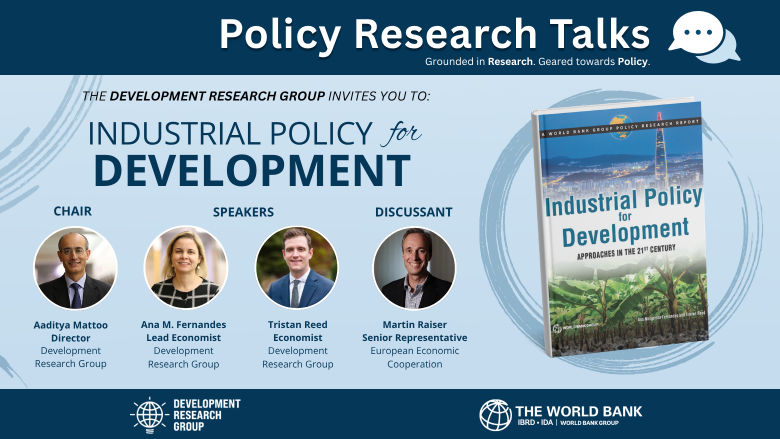
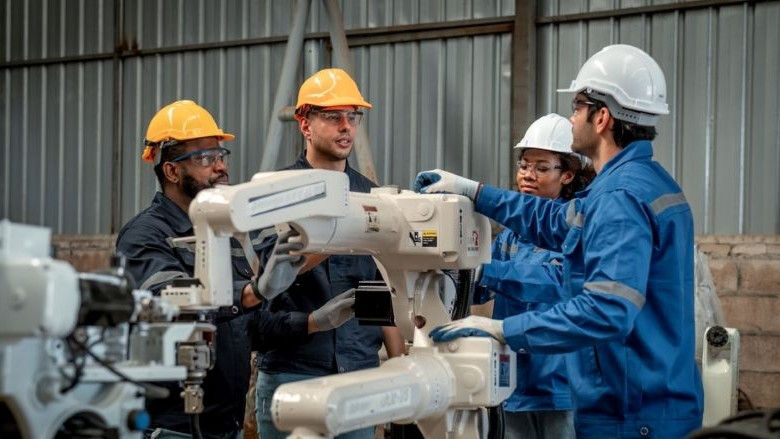
Industrial Policy for Development
Amidst slower global growth, a shifting labor market, and rising protectionism, governments are increasingly turning to a once controversial tool—industrial policy.